
Why Your Rank Tracker and Google Search Console Never Agree
This month when we released FTD Dominators we receive a message from one of the brands mentioned. We showed them dropping out of the first page rankings, but their SEO team showed Search Console showed they were still among the first page. They wanted to know which one is wrong?
It's a fair question, however, it's also the wrong question.
A rank tracker and Google Search Console aren't measuring the same thing with different accuracy. They're measuring different things entirely.
What a rank tracking snapshot actually is
When a rank records a position, it does something very specific: it fetches a real Google results page for one keyword, from one location, on one device type, at one moment in time, with all personalisation stripped out.
Think of it as a photograph. On the 1st of the month, a depersonalised UK mobile search for "online casino" returned this exact page of results, and your domain was the fourth organic listing on it. That's the fact being recorded.
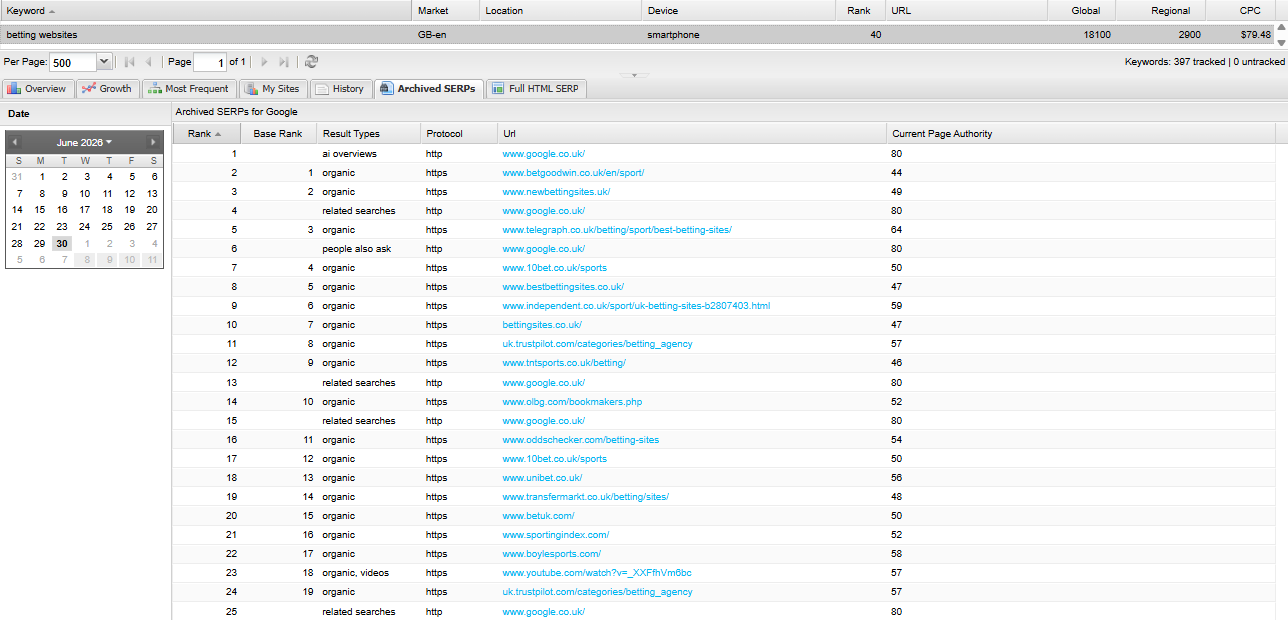
Rank trackers exist so that every site in the report is measured under identical conditions; same keyword, same location, same device, same moment. The comparison between competitors is clean. FTD Dominators can say Brand A holds more page-one positions than Brand B and mean it, because both were photographed with the same camera at the same time.
The trade-off is that a photograph captures a single moment in time. Google reshuffles results constantly and is especially volatile on commercial terms like iGaming keywords. A snapshot taken in the morning can legitimately differ from one taken Tuesday afternoon.
What GSC's average position actually is
Google Search Console's average position number is not taking a photograph. It is acting more like a GPS log of everywhere your site has been, averaged over the time period you select into a single coordinate.
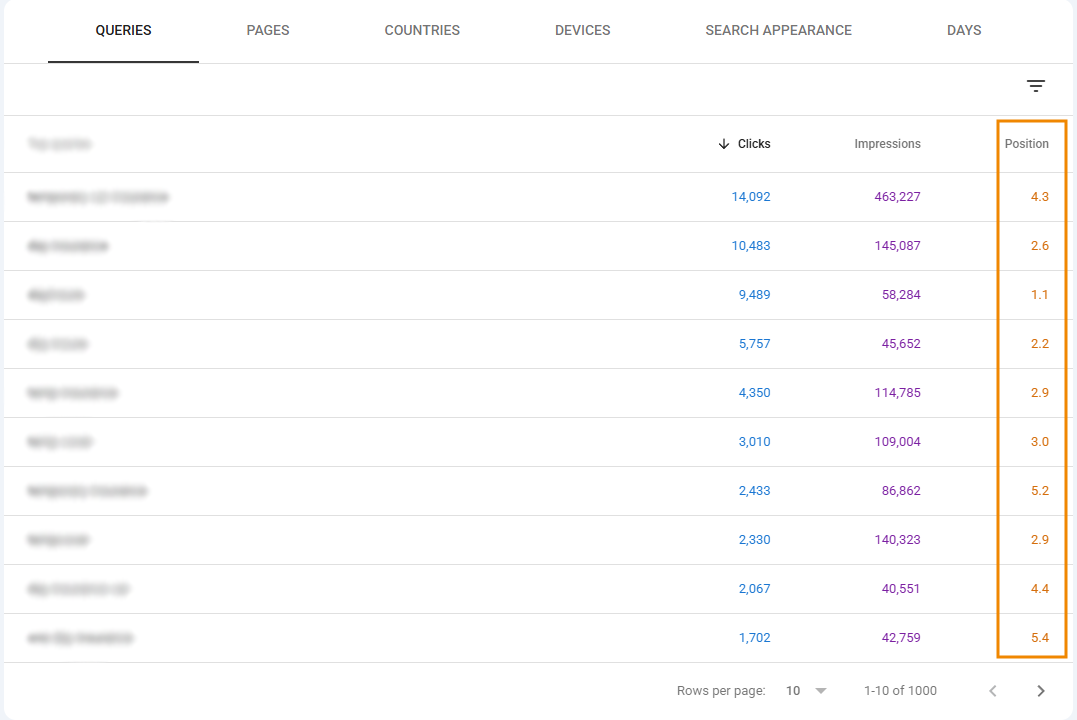
GSC records your position every time your site appeared in a real user's search results. It looks at every user, every location, every device, every personalised and localised variation of the SERP and then averages all of those recorded positions across whatever date range you've selected.
That single design difference produces almost all of the divergence people notice. A few specifics worth knowing:
It's an average across time: If you ranked 3rd for the first half of the month and 12th for the second half, GSC reports something like 7.5; a position you may never have actually occupied on any real results page.
It's an average across queries and pages: Look at position at the property level and you're blending every query and every ranking URL together. Your money page might sit at position 2 while a blog post scrapes impressions at position 45 for a tangential query. That blog post drags your "average" down without your rankings having moved at all.
It only counts when someone actually searched: GSC logs a position when an impression happens. Rank trackers check on a fixed schedule regardless. If you rank well for a keyword nobody searched much that week, the tracker sees it; GSC barely does.
It counts every location and personalisation: A user in Manchester, a user in Gibraltar, and a user who visits your site daily all see slightly different SERPs. GSC averages all of them. A rank tracker deliberately avoids all of this additional noise.
Position isn't just the blue links: In GSC, your position reflects wherever your result block appeared. It doesn’t take into account SERP features, image packs, and other elements which all occupy positions. On a modern SERP crowded with features, "position 4" in GSC and "fourth organic listing" in a rank tracker are not the same claim.
Deep positions dilute the number: If your listing on page 3 gets rendered because one user (real or bot) scrolled that far, that position 25 goes into your average. Rank trackers typically report your best-known position for the keyword instead.
So, which one should you trust?
Well, both for different jobs.
Use a rank tracker when the question is competitive: who owns page one, who's gaining, who's slipping, how does visibility compare to rivals under identical conditions. That's a benchmarking question, and it needs the controlled like-for-like snapshot. It's why FTD Dominators is built on fixed keyword sets photographed the same way every month.
Search Console should be used when the question is about your own real-world performance: what queries actually drove impressions and clicks, how visibility trends over time, where the genuine traffic opportunities sit. GSC is the ground truth of what real users experienced. It may be messy and averaged, but it is real world data.
Where teams go wrong is cross-referencing them as if they should match. They shouldn't. Expecting a monthly impression-weighted average across thousands of query variations to equal a single depersonalised snapshot on one keyword is expecting your season batting average to match one specific at-bat. Wow, I got a cricket reference into a SEO article… even I’m impressed.
The practical takeaway
If your SEO team pulls up GSC and sees a different number than a ranking snapshot shows, the reconciliation checklist is short:
1. Match the query exactly. Filter GSC to the precise keyword, not the property-wide average.
2. Match the geography. Filter to the country the snapshot was taken in.
3. Match the device. Desktop and mobile SERPs differ more than most people expect.
4. Match the date. Narrow GSC to the day (or days) around the snapshot, not the default 3-month range.
5. Check which URL ranked. GSC may be averaging across multiple ranking pages.
Do all five and the numbers usually land within touching distance of each other. Whatever gap remains is the honest residue of averaging real user SERPs versus photographing one clean one. Remember that gap is a feature of the methodology, not a flaw in either tool.
The brands that win in competitive SEO aren't the ones arguing about which number is "right." They're the ones who know which question each number answers.
FTD Dominators tracks page-one Google visibility across 100 high-intent keywords in Online Casino, Sports Betting, and Bingo, refreshed monthly under identical conditions. If your SEO team wants to walk through the methodology, get in touch.